
E-Learning Use Cases
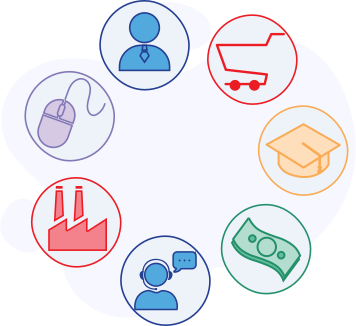
E-learning drives results across industries, helping corporates and financial services meet compliance and grow skills, enabling faster onboarding in software and support training, improving efficiency in retail and manufacturing, and offering flexible, engaging learning in education.

Corporate Training
E-learning provides corporate businesses with a cost-effective and flexible way to train employees at scale. It ensures consistent learning across teams and locations, supporting everything from onboarding and compliance to leadership and skill development.
Employees can learn anytime, anywhere, reducing downtime and increasing productivity. Companies save on travel and training costs while gaining insights through tracking and analytics. Overall, e-learning helps build a more agile, skilled, and competitive workforce.

Software Training
E-learning is an effective and scalable solution for software application training, helping users quickly learn how to use new tools and features. It provides interactive, step-by-step modules that allow learners to practice in simulated environments, improving retention and confidence.
Users can access training anytime, on any device, making it easy to learn at their own pace without disrupting workflows. E-learning also reduces the need for in-person sessions, lowers training costs, and ensures consistent instruction across teams or customer groups. This leads to faster adoption, fewer support requests, and better overall use of the software.

Retail
E-learning offers a fast, flexible, and cost-effective way to train retail staff across multiple locations. It ensures consistent instruction on product knowledge, customer service, sales techniques, and store procedures, helping employees deliver a better shopping experience.
Staff can complete training on any device, in their own time, reducing downtime and improving retention. E-learning also supports quick onboarding, seasonal staff training, and real-time updates on promotions or policy changes. By streamlining learning, e-learning boosts employee performance, customer satisfaction, and overall store efficiency.

Financial Services
E-learning provides a secure, efficient, and scalable solution for training in the financial services industry. It helps employees stay up to date with regulatory requirements, financial products, compliance protocols, and industry trends, all through consistent, trackable digital modules.
Staff can access training anytime, on any device, allowing for flexible learning without disrupting daily operations. E-learning also supports faster onboarding, reduces training costs, and enables continuous skill development. This leads to improved accuracy, better client service, and stronger compliance across the organization.

Support Agent Training
E-learning is an effective way to train support agents quickly and consistently. It provides interactive modules on product knowledge, communication skills, troubleshooting, and customer service protocols—helping agents build confidence and competence.
Agents can learn at their own pace and revisit materials when needed, which improves retention and reduces onboarding time. E-learning also allows for regular updates on new features or processes, ensuring agents stay current. This leads to faster issue resolution, better customer experiences, and improved overall support team performance.

Manufacturing Industries
E-learning offers a practical and efficient way to train manufacturing employees on safety protocols, equipment handling, standard operating procedures, and quality control. It enables consistent training across shifts and locations, reducing errors and improving workplace safety.
Workers can access modules on-demand, minimizing downtime and allowing for flexible learning without stopping production. E-learning also simplifies onboarding, supports regulatory compliance, and reduces training costs. By improving knowledge retention and operational efficiency, it helps manufacturers maintain high standards of productivity and safety.

Support Agent Training
E-learning is an effective way to train support agents quickly and consistently. It provides interactive modules on product knowledge, communication skills, troubleshooting, and customer service protocols—helping agents build confidence and competence.
Agents can learn at their own pace and revisit materials when needed, which improves retention and reduces onboarding time. E-learning also allows for regular updates on new features or processes, ensuring agents stay current. This leads to faster issue resolution, better customer experiences, and improved overall support team performance.

Pictualize Digital Media (Pty) Ltd